

Single-walled carbon nanotube thin films are among the most promising platforms for flexible electronics and scalable device integration. They can be spray-coated onto substrates, patterned, and manufactured with relative ease. But their real-world performance falls far short of what individual nanotubes can achieve, and the reason is structural. Everywhere one nanotube meets another in the network, only weak van der Waals forces hold the junction together. These loose contact points scatter electrons and block heat flow, degrading conductivities by several orders of magnitude.
Why not simply use graphene instead, which naturally forms continuous two-dimensional sheets? Because directly synthesizing large-area, uniform, multilayer graphene remains a formidable manufacturing problem. Chemical vapor deposition, the most common route, typically requires temperatures above 1000 °C, controlled atmospheres, and transfer steps that introduce defects.
A more elegant approach is to start with the nanotube network that is already easy to fabricate and transform it in place, converting the tubes themselves into graphene sheets that merge with one another. This eliminates the weak junctions not by strengthening them but by erasing them entirely.
Yet previous attempts have required extreme conditions: diamond-anvil pressures above 22 gigapascals, dynamic shock compaction beyond 36 gigapascals with temperature spikes reaching 700 to 1200 kelvin, graphitization furnaces at 2700 °C, or harsh chemical treatments. None has offered a practical route to this in-place transformation under mild conditions.
A study published in Advanced Functional Materials (“One‐Step Transformation of Single‐Walled Carbon Nanotube Networks into High‐Performance Multilayer Graphene‐Rich Films via Laser Shockwave Compaction”) now demonstrates that laser‐induced shockwaves can accomplish this conversion in a single, chemical‐free step. Working without external heating and at a pressure of roughly 2.27 gigapascals per pulse, the researchers transformed single-walled carbon nanotube films into multilayer graphene-rich structures.
No external heating was applied, though the laser exposure itself raised the sample surface temperature to just below 120 °C, as confirmed by thermal recording paper. The resulting films exhibited a sevenfold increase in thermal conductivity and a 2.6-fold increase in electrical conductivity, the largest thermal conductivity improvement among comparable processing techniques cited in the study.
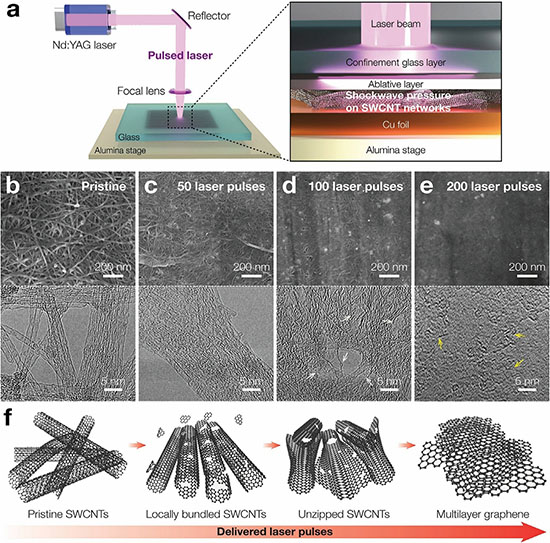
The technique relies on plasma-driven pressure pulses. A nanosecond-pulsed Nd:YAG laser, fired at 1.13 GW cm⁻², strikes a thin aluminum foil coated with black paint, vaporizing a layer of metal into plasma that expands explosively. A borosilicate glass plate above traps that expansion, channeling it downward as a gigapascal-pressure shockwave into the nanotube film, which sits on an alumina substrate beneath the aluminum. The team applied between 50 and 200 such pulses, replacing the aluminum foil every 50 to maintain effective absorption.
The transformation unfolded in stages. After 50 pulses, the nanotubes compressed into tightly packed bundles, accumulating defects but retaining their tubular form. By 100 pulses, repeated shockwaves had concentrated stress at defect sites in the nanotube walls, causing individual tubes to unzip along their length into flat, open-edged strips. After 200 pulses, these unzipped lattices stacked and coalesced into crystalline multilayer graphene. The film's thickness shrank by up to 61%.
The widths of the unzipped structures, 2.5 to 5.2 nanometers, matched the expected circumference of the original nanotubes when laid flat, directly confirming that the graphene originated from opened-up tubes.
High-resolution transmission electron microscopy showed both double-layer and multilayer graphene with an average interlayer spacing of 3.53 angstroms, consistent with equilibrium graphite, and electron diffraction displayed the sixfold symmetry and honeycomb lattice characteristic of graphene.
Raman spectroscopy captured the transformation's arc. The radial breathing mode, a unique vibration to intact nanotubes, further weakened as tubular geometry disappeared. The disorder-related D-band first intensified as defects accumulated and tubes split open, then subsided after 200 pulses as the fragmented lattices fused into continuous graphene. The 2D-band, sensitive to graphene interlayer interactions, doubled in intensity, consistent with graphitization.
Once the graphene domains fully coalesced, the electrical and thermal gains were substantial. Electrical conductivity rose from 0.068 to 0.18 MS m⁻¹, while in-plane thermal conductivity jumped from 9.52 to 66.25 ± 7.16 W m⁻¹ K⁻¹. Volumetric heat capacity tripled.
At intermediate pulse counts, thermal conductivity improved before electrical conductivity did, because edge sites from partially unzipped tubes scatter charge carriers more effectively than they impede phonon transport. Electrical conductivity caught up only after 200 pulses, when the continuous graphene network was fully established.
Complete conversion remains elusive. Some intact nanotubes and amorphous carbon persist within the transformed films, and controlling the exact number of graphene layers remains an open problem. But the authors suggest this partial transformation may itself hold value.
The resulting hybrid network, where continuous graphene domains connect seamlessly to remaining nanotube segments, constitutes a carbon heterostructure that no direct synthesis route currently produces.
The authors propose that this method could pave the way for engineering seamless junctions within such nanotube-graphene heterostructures, opening possibilities for applications that benefit from the distinct properties each carbon form contributes.
The absence of external heating makes the technique potentially compatible with heat-sensitive substrates used in flexible electronics, and the authors describe the method as scalable. For energy storage, thermal management, and multifunctional carbon films, it provides what has been missing: a way to convert an already-manufactured nanotube network into a high-performance graphene-rich architecture without dismantling it and starting over.